The (Ideal) Path to Diagnosis
Reflections on the diagnostic journey
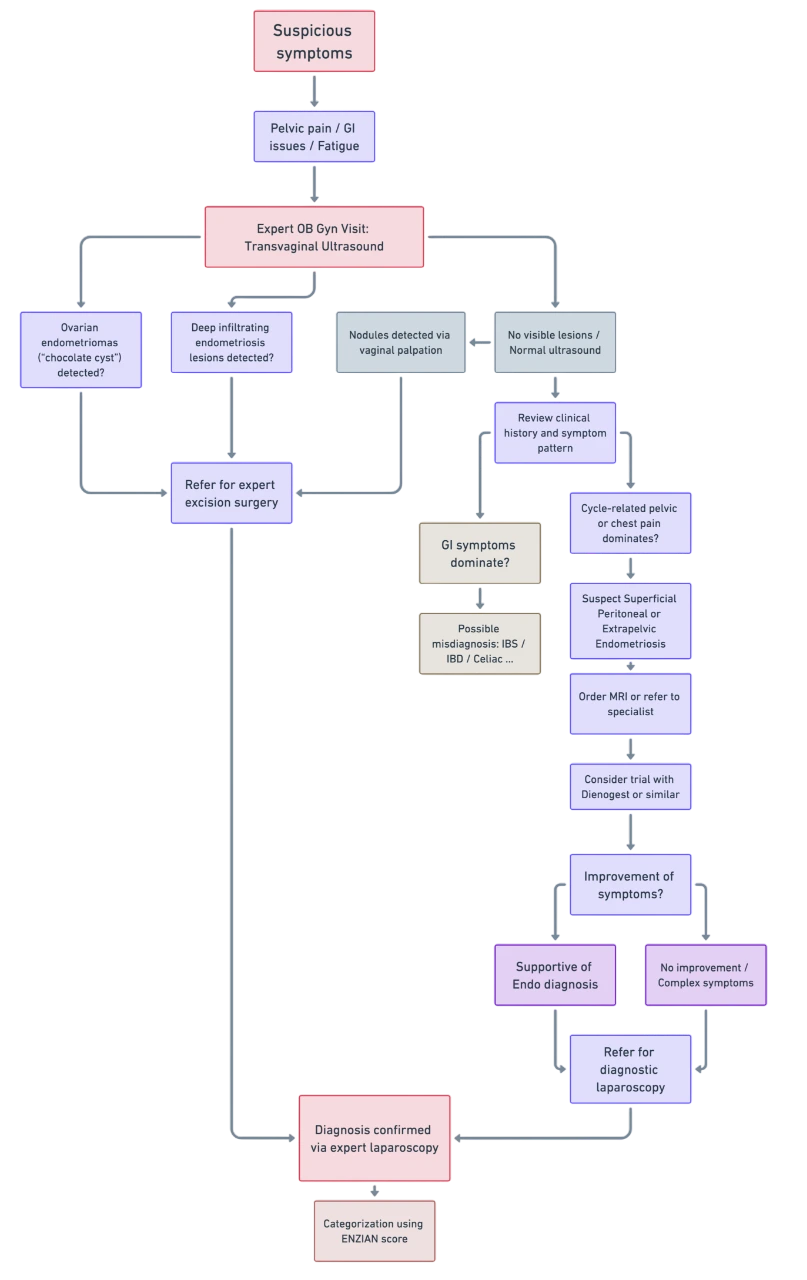
...and everything leads to laparoscopy
Current State (2026): Luckily, modern ultrasound techniques have improved significantly in recent years for detecting certain forms of endometriosis - such as ovarian endometriomas ("chocolate cysts") and deep infiltrating endometriosis - not least due to improved image resolution. However, the only definitive method for a clinical diagnosis of all types of endometriosis remains expert laparoscopy which yields histological samples. Even if called a 'minimally invasive surgical procedure', it can take its toll on the patient, but it allows direct visualization and, if necessary, the immediate removal of lesions. Therefore, laparascopy is currently the gold standard for an accurate diagnosis.
As you can see from the flowchart above, endo belongs in expert hands and can only achieve a quick diagnosis there, preventing unnecessary further suffering. More about endo categories and the ENZIAN score can be found on the What is Endo? page.
What is Endometriosis?
Understand the disease
Appeal to Research: Enable Faster Diagnosis for Endometriosis
Endometriosis affects millions of people worldwide and yet it often takes years, sometimes even decades, to receive a correct diagnosis. I created a flowchart to visualize this complex diagnostic journey and would like to share some thoughts.
Key Insights:
- Clinical expertise remains crucial – especially in interpreting imaging, recognizing atypical presentations, and listening: The individual patient experience is central.
- One of the most challenging steps often lies at the very beginning: "Suspicious symptoms". This is where the challenge begins, as endometriosis often presents in different, often non-specific ways:
- Chronic pelvic pain (not necessarily cycle-dependent)
- Infertility or cycle-dependent pain in chest or shoulder
- Gastrointestinal complaints mistaken for irritable bowel syndrome
- Fatigue and elevated inflammation markers without clear cause
Here Lies Hope
Research and AI-powered tools are opening new perspectives:
- Non-invasive biomarkers for early detection (e.g., Diamens from Linz)
- AI-assisted imaging to make even subtle lesions visible (e.g., Scanvio Medical from Zurich)
Imagine a future where a simple, non-invasive biomarker test raises early alarms, or AI provides imaging insights that might escape even experienced specialists. These developments are not science fiction - they are happening NOW and could help finally break through the long diagnostic delay.
I share this flowchart not only as a visualization but also as an invitation to ponder: How can we best unite clinical experience and new technologies to optimize endo diagnosis?
More about current developments in endometriosis research can be found in the Blog or you can browse directly through the Studies.
Frequently Asked Questions
Common questions about how endometriosis is diagnosed.
Persistent or recurring pain in the lower abdomen during or outside of menstruation, during or after sex (dyspareunia), and pain when urinating or having a bowel movement. Also fatigue, as well as infertility or difficulty conceiving. These are just some of the symptoms, as endometriosis can be very complex.
A gynecologist experienced in endometriosis should diagnose endometriosis, and if you suspect you may have it, you should ideally seek out a certified endometriosis center to avoid diagnostic delays. Since the condition can present with a wide range of symptoms, well-informed general practitioners or internists are also capable of raising a suspicion.
Deep infiltrating endometriosis can often be suspected via vaginal ultrasound or palpation due to its extent, thickness, and impact on adjacent organs. Endometriomas (chocolate cysts) on the ovaries are also detectable on ultrasound. More superficial forms of endometriosis (which can be just as painful), such as peritoneal endometriosis, are often not visible on ultrasound. Even during a diagnostic laparoscopy, identifying or removing these lesions requires considerable expertise on the part of the surgeon.
Histological confirmation via surgery remains the only definitive diagnosis of endometriosis, as this allows the diseased tissue to be directly seen and removed. However, advances in imaging mean that a suspicion can now be raised in part through vaginal ultrasound or MRI. Biomarkers from menstrual or venous blood are in development but do not yet offer sufficient diagnostic certainty. The ESHRE guidelines (as of 2022) now acknowledge that a clinical diagnosis based on symptoms and typical imaging findings can be sufficient to begin treatment without requiring surgery first.
Laparoscopy, also known as keyhole surgery, is a minimally invasive surgical procedure performed through usually 3 small incisions in the lower abdomen. It requires general anesthesia. If lesions are excised, patients can usually be discharged within a few days; for a purely diagnostic procedure, this may even be on the same or the following day. However, purely diagnostic operations should be avoided in endometriosis — where possible, simultaneous removal of lesions should always be the goal, as each additional surgery carries a risk of adhesions.
It very much depends on the specialist you approach with your concerns. In self-help groups, you will often hear of women who were put off or dismissed for 15 years or more. But there are also fortunate cases where well-informed patients are referred to a specialist relatively quickly and receive their diagnosis in under a year. Studies show that the average diagnostic delay is 7–12 years.