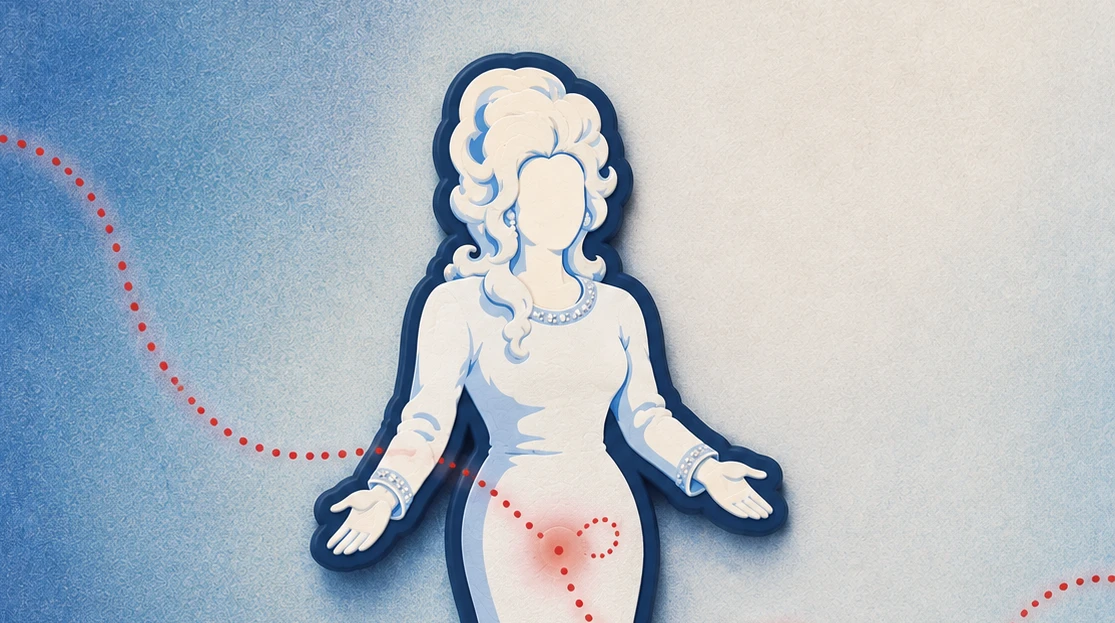
Yesterday, the world lost Dolly Parton.
The older I got, the more I grew to appreciate her — for her unrelenting vision and drive, and not least for her music.
She was a trailblazer for women in the music industry and beyond, a true generational icon.
For my father, she was the "country singer with a distinct voice" that he enjoyed. For me, she became so much more.
I wasn't fully aware of her struggle with endometriosis. And yet this is a part of her story that deserves a little more attention: Dolly lived with endometriosis.
In the early 1980s, at the height of her career, she suffered severe pain and bleeding and underwent repeated gynecological treatment and surgery. She was diagnosed with endometriosis and underwent a partial hysterectomy. She later spoke about the profound effect that time in her life had on both her physical and mental health.
Now think about the decade in which this happened. (Which also reminds us: endo was around back then in full force.)
Today we know that hysterectomy is not a solution for endometriosis. It can indeed be helpful in specific cases of adenomyosis, when the uterus is the main source of pain, but given the growing evidence for immunological, genetic, and environmental drivers of endometriosis, hysterectomy often functions more as a symptomatic measure than a definitive cure.
Back then there was no hashtag "endometriosis awareness". No social media community comparing symptoms and exchanging notes about surgeons and their expertise. No widespread understanding that even a hysterectomy does not necessarily cure endometriosis. Women's pelvic pain was barely a topic at all — readily dismissed or simply kept private.
And yet Dolly spoke openly about her "female problems": why she was medically unable to have children, surgery, and the grave emotional consequences of losing control over her own body.
This last aspect we endo patients know all too well: losing faith in our own observations and slowly getting the trust in our bodies eroded by medical gaslighting.
Dolly put it all out there, simply refusing to pretend that none of it had happened. This made her an unusually early public voice for a dark reality millions of women were experiencing largely in silence.
Behind the voluminous hair, the rhinestones and glitter, behind the carefully constructed and upheld picture of femininity, was a woman who consistently claimed ownership of her work, her image, her business decisions and her story.
Before women's pain had any visibility, Dolly Parton was already talking about hers.
Thank you, Dolly. 🦋